
(be)love(d)
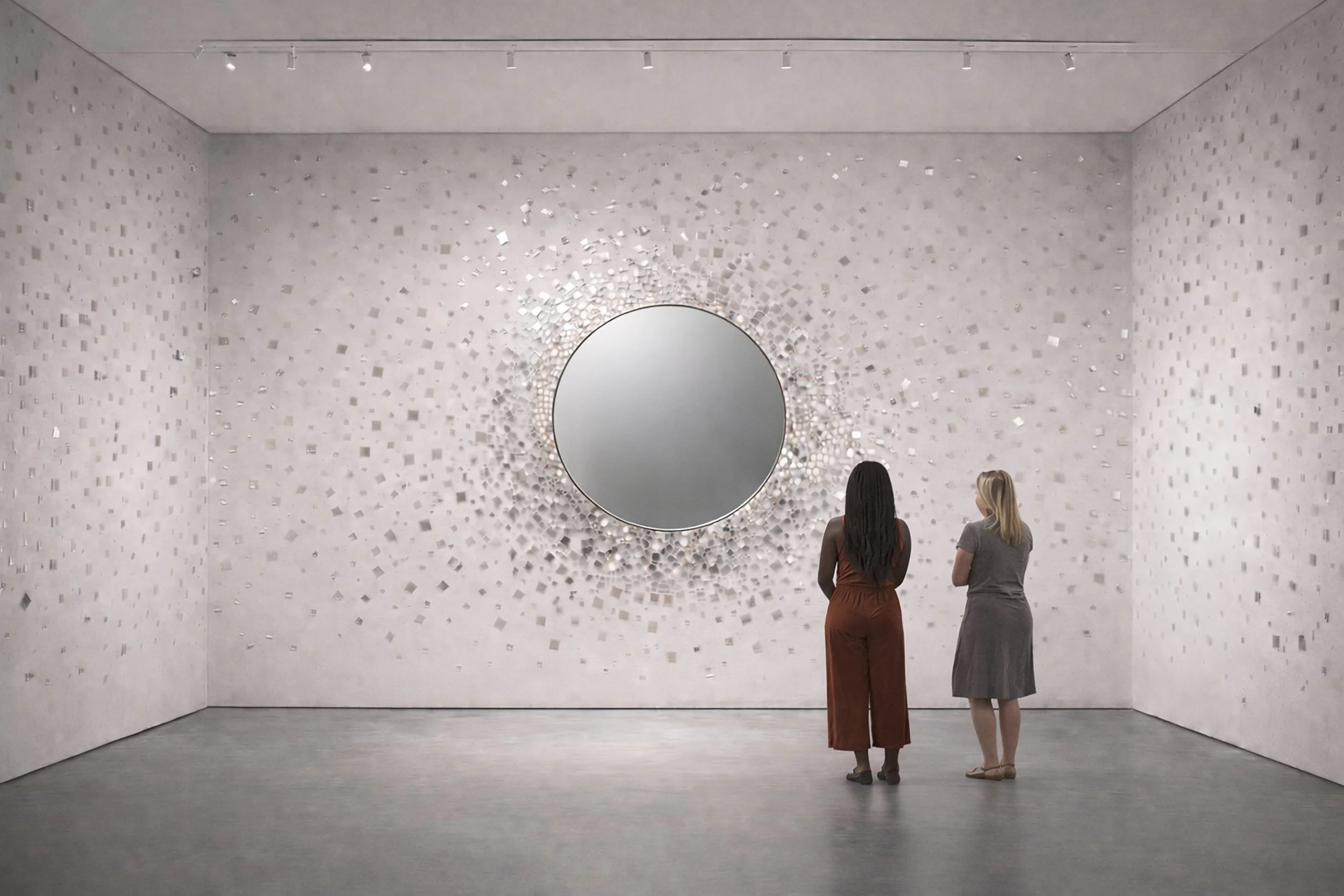
I have a vision for an exhibit I hope to make, based on what I’ve taken away from Table Manor: an interactive experience designed to help people recognize one another—and themselves—through attention, presence, and witnessing.
This project begins from a simple premise: we are mirrorborn. Each person is a singular life, shaped by circumstance and story, and at the same time a facet of something shared. Much of human life is organized around maintaining the “I,” the small self we learn to protect, explain, and defend. This is how we learn to move through the world. Over time, however, this constant attention to the self can cloud the surface through which we encounter one another.
Turning toward the small self is part of embodiment—a descent into form that makes recognition possible. But as the surface clears, the Beloved appears—looking through us, looking at us.
Drawing on contemplative traditions that understand the mirror not as an instrument of self-surveillance but as a receptive presence, the exhibit uses a double-sided mirror to create moments of encounter and witnessing. Participants are invited to stand before and move through reflective surfaces.
At times, others may be present on the opposite side of the glass, quietly witnessing. Seeing and being seen begin to overlap. In this overlap, the work opens a third space, a liminal field between subject and object, observer and observed.
Across cultures and disciplines, people return to a similar recognition: that the self we defend is not the whole of who we are, and that separation is not as solid as it seems. Sometimes this recognition arrives as awakening, sometimes as an inner kingdom, sometimes as the unraveling of illusion, sometimes as a kind of entanglement that resists explanation. The words change. Meanings shift. And still, the shape of the experience keeps returning.
(be)love(d) is oriented toward awe rather than evaluation. Rather than asking the viewer to assess or correct what they see, awe suspends judgment altogether. In this pause, the critical gaze softens and the mirror opens as a site of wonder, an encounter with beauty not as reassurance, but as recognition.
Because awe cannot be instructed or explained, the work keeps language sparse. Text, when present, is minimal and permeable, designed to appear and recede with the light, much like a surface that alternately clouds and clears. What remains is experience: brief, embodied moments that draw attention toward beauty, presence, and one another, without requiring interpretation or belief.
(be)love(d): being itself is both offering and receiving.
Want to help me bring the project to life?